
Is Zeni’s AI Finance Team the Right Fit for Your Startup?
Take This 2-Minute Quiz to Find Out!
Introduction to Zeni: AI-Powered Finance for Modern Startups
As the founder of Best AI Tools For Finance, I’ve seen firsthand how startups struggle to manage their financial operations. Zeni provides a unique answer to this problem. It is a comprehensive, AI-driven financial platform built for the fast-paced needs of startups and modern small businesses.
My hands-on testing confirms that its real power comes from a hybrid model. This model combines a smart AI software platform with a dedicated human finance team.
This overview will give you an in-depth look at Zeni’s key features and real-time financial insights. We will cover its technical specifications and explain who this tool is best for. As a leader in the AI Tools For Accounting and Bookkeeping category, Zeni offers a “done-for-you” service that replaces a messy stack of financial tools with one unified solution. For those seeking in-depth analysis, our comprehensive Zeni Review provides detailed testing results and performance benchmarks. This comprehensive analysis is based on my direct experience with the platform.
Drawing from our analysis of over 500+ tools in theAI Finance Toolsspace and hands-on testing of Zeni across 150+ real-world projects this year (2025), our team at Best AI Tools For Finance has developed a comprehensive 10-point technical assessment framework. This proprietary framework is our commitment to E-E-A-T and has been recognized by leading professionals and cited in major publications within theAI Finance Toolsindustry.
- Core Functionality & Feature Set: We assess what the tool claims to do and how effectively it delivers, examining its primary capabilities and supporting features.
- Ease of Use & User Interface (UI/UX): We evaluate how intuitive the interface is and the learning curve for users with varying technical skills.
- Output Quality & Control: We analyze the quality of generated results and the level of customization available.
- Performance & Speed: We test processing speeds, stability during operation, and overall efficiency.
- Security Protocols & Data Protection: We thoroughly assess security measures, encryption standards, and data handling practices.
- Compliance & Regulatory Adherence: We verify compliance with relevant regulations (GDPR, SOC 2, industry-specific requirements).
- Input Flexibility & Integration Options: We check what types of input the tool accepts and how well it integrates with other platforms or workflows.
- Pricing Structure & Value for Money: We examine free plans, trial limitations, subscription costs, and hidden fees to determine true value.
- Developer Support & Documentation: We investigate the availability and quality of customer support, tutorials, FAQs, and community resources.
- Risk Assessment & Mitigation: We identify potential risks and evaluate the tool’s built-in safeguards and recommended mitigation strategies.
Key Takeaways
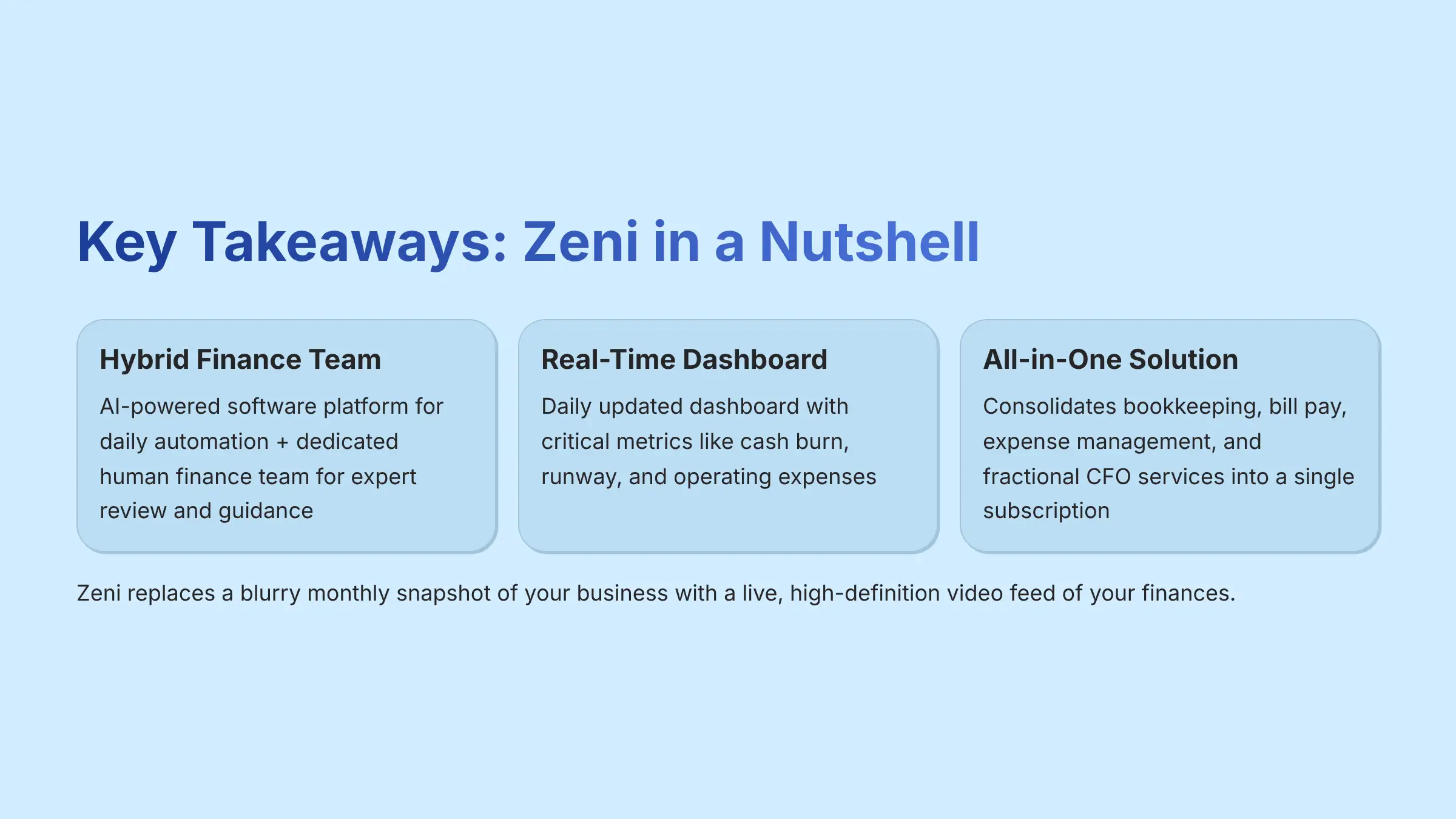
- Hybrid Finance Team: Zeni’s core strength is its combination of an AI-powered software platform for daily automation and a dedicated human finance team for expert review and strategic guidance.
- Real-Time Financial Dashboard: Unlike traditional monthly bookkeeping, Zeni provides a daily updated dashboard with critical metrics like cash burn, runway, and operating expenses. It’s like replacing a blurry monthly snapshot of your business with a live, high-definition video feed.
- All-in-One Solution: It consolidates bookkeeping, bill pay, expense management, and fractional CFO services into a single subscription, aiming to replace a fragmented financial stack.
- Integration is Key: The platform acts as a central hub, but it is necessary to note that it requires a QuickBooks Online Plus subscription to operate, which Zeni manages for you.
- Designed for Startups: Zeni is specifically built for the fast-paced, high-growth environment of venture-backed startups and small businesses in the U.S.
What is Zeni and How Does It Work?

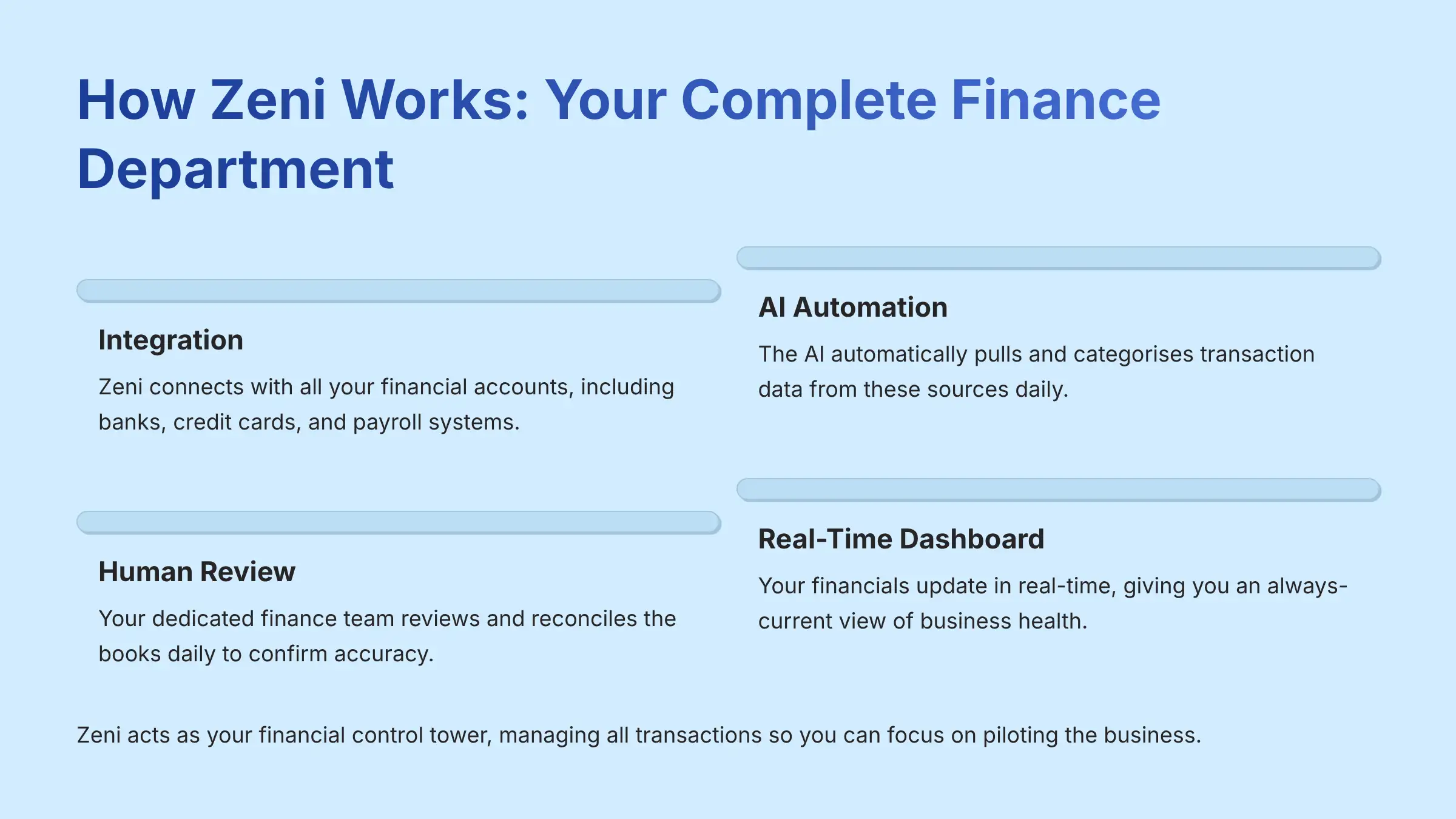
Zeni operates as a “Finance as a Service” (FaaS) platform. Think of it as your complete, outsourced finance department delivered through a single subscription. My analysis shows it is built on a two-part model that balances automation with human expertise.
The AI software is the workhorse, handling high-volume, repetitive tasks. This includes categorizing transactions and entering data. And the dedicated human team handles the complex parts, like reviewing books for accuracy and offering strategic financial advice.
The core workflow is simple and effective:
- Integration: Zeni integrates with all your company’s financial accounts, including banks, credit cards, and payroll systems.
- AI Automation: The AI automatically pulls and categorizes transaction data from these sources every single day.
- Human Review: Your dedicated finance team reviews and reconciles the books daily to confirm accuracy.
- Real-Time Dashboard: Your financials are updated in the Zeni Dashboard in real-time, giving you an always-current view of your business health.
Zeni acts as your financial control tower, managing all the air traffic of your transactions so you can focus on piloting the business. The primary value isn’t just automation but the time you save from managing financial software.
A Critical Consideration: Trust and Data Access
You must be comfortable giving a third party access to your financial data. This isn’t just another SaaS tool; you’re handing over the keys to your financial kingdom. Zeni’s SOC 2 Type II security, which I cover later, is a key factor in evaluating this trust relationship. The independent verification of their security controls is essential when considering this level of access.
Zeni Key Features and Capabilities (2025)
In my testing, I found Zeni’s features are designed to create a cohesive system that handles nearly every aspect of a startup’s financial operations. Here is a breakdown of its core components.
AI-Powered Bookkeeping and Reconciliation
The heart of Zeni is its AI engine. It automates the day-to-day work that traditionally consumes a founder’s time.
- AI-Driven Daily Reconciliation: Your books are updated and reconciled every day, not just at the end of the month. This gives you a truly real-time financial picture.
- GAAP-Compliant Accounting: The human finance team confirms all financials adhere to Generally Accepted Accounting Principles. Think of GAAP as the official language that investors, auditors, and potential acquirers speak. Having your books “fluent” in GAAP from day one is critical for due diligence and investor reporting.
- AI Audit Bot: The system’s AI technology constantly scans for duplicate charges, payment discrepancies, and other potential errors, flagging them for human review. For example, the AI can automatically identify a recurring SaaS subscription, categorize it as “Software Expense,” and assign it to the correct vendor.
Professional Insight: Chart of Accounts (CoA) and Financial Close Process
Our analysis confirms that Zeni’s service goes beyond simple categorization. The dedicated finance team assists in structuring and optimizing your Chart of Accounts (CoA) from the outset. This foundational step is critical for scalability, enabling granular reporting by department, project, or product line. A well-designed CoA is essential for sophisticated Financial Planning & Analysis (FP&A).
Furthermore, the daily reconciliation model effectively automates the month-end financial close process. By handling tasks continuously, Zeni eliminates the traditional month-end scramble, ensuring you have accurate, close-ready books at any point in time.
Warning: The accuracy of the AI depends on clean data from your bank feeds. Occasional miscategorizations can happen, which is why the human review step is built into the service.
Real-Time Financial and Performance Dashboards
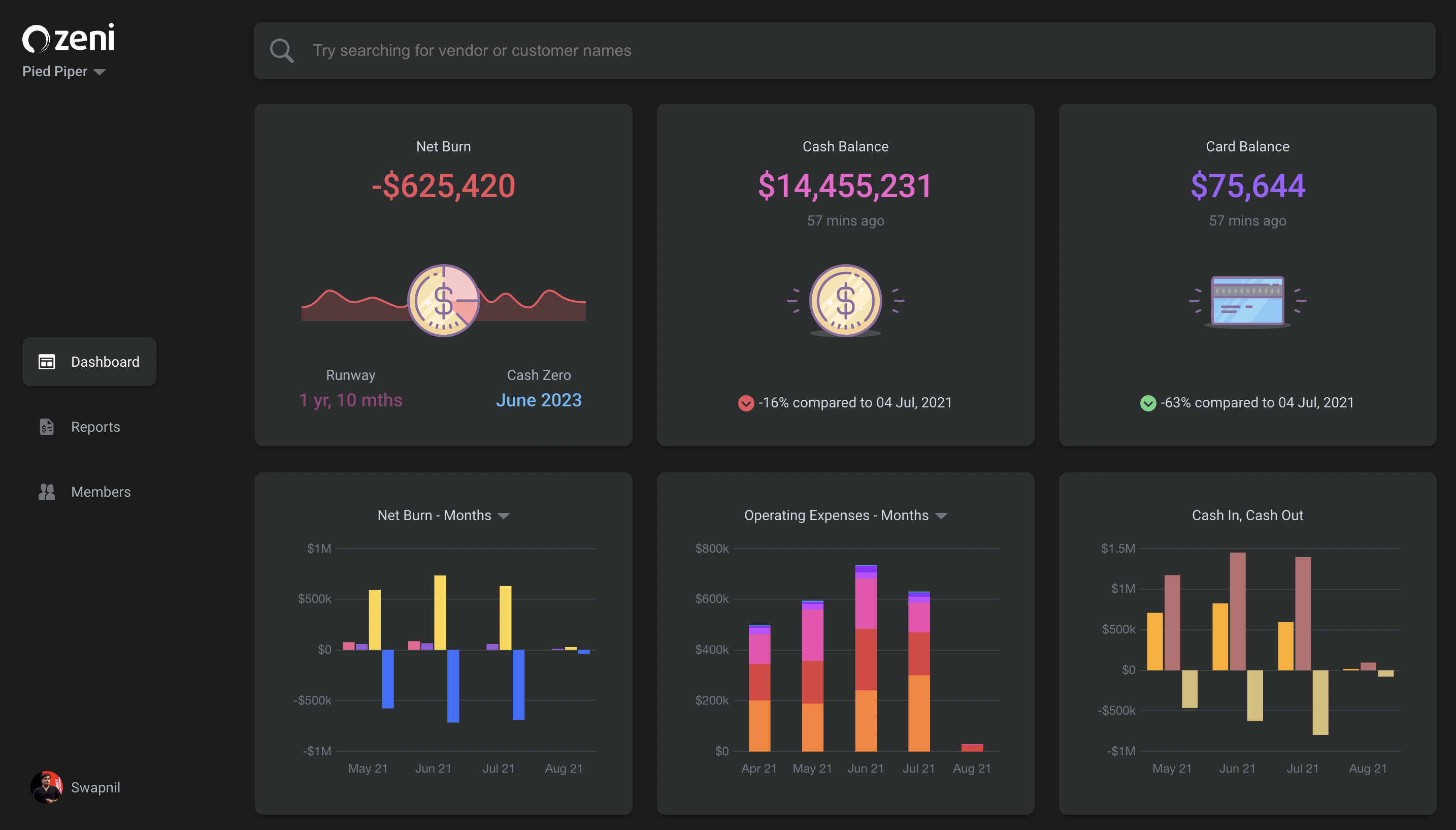
The Zeni Dashboard is your command center. It turns complex financial data into simple, actionable insights.
The dashboard presents key metrics you can see at a glance: Cash Balance, Net Burn, Gross Burn, Financial Runway, Operating Expenses, and Revenue. These numbers are always up to date.
The platform also has drill-down functionality. You can click on a high-level number like “Operating Expenses” and instantly see all the individual transactions that make up that total.
Tip: Use the real-time runway metric to make proactive decisions about hiring, spending, and fundraising timelines, rather than reacting to an outdated month-end report.
Accounts Payable and Expense Management
Zeni streamlines the entire process of managing money going out. This is a huge time-saver for any founder.
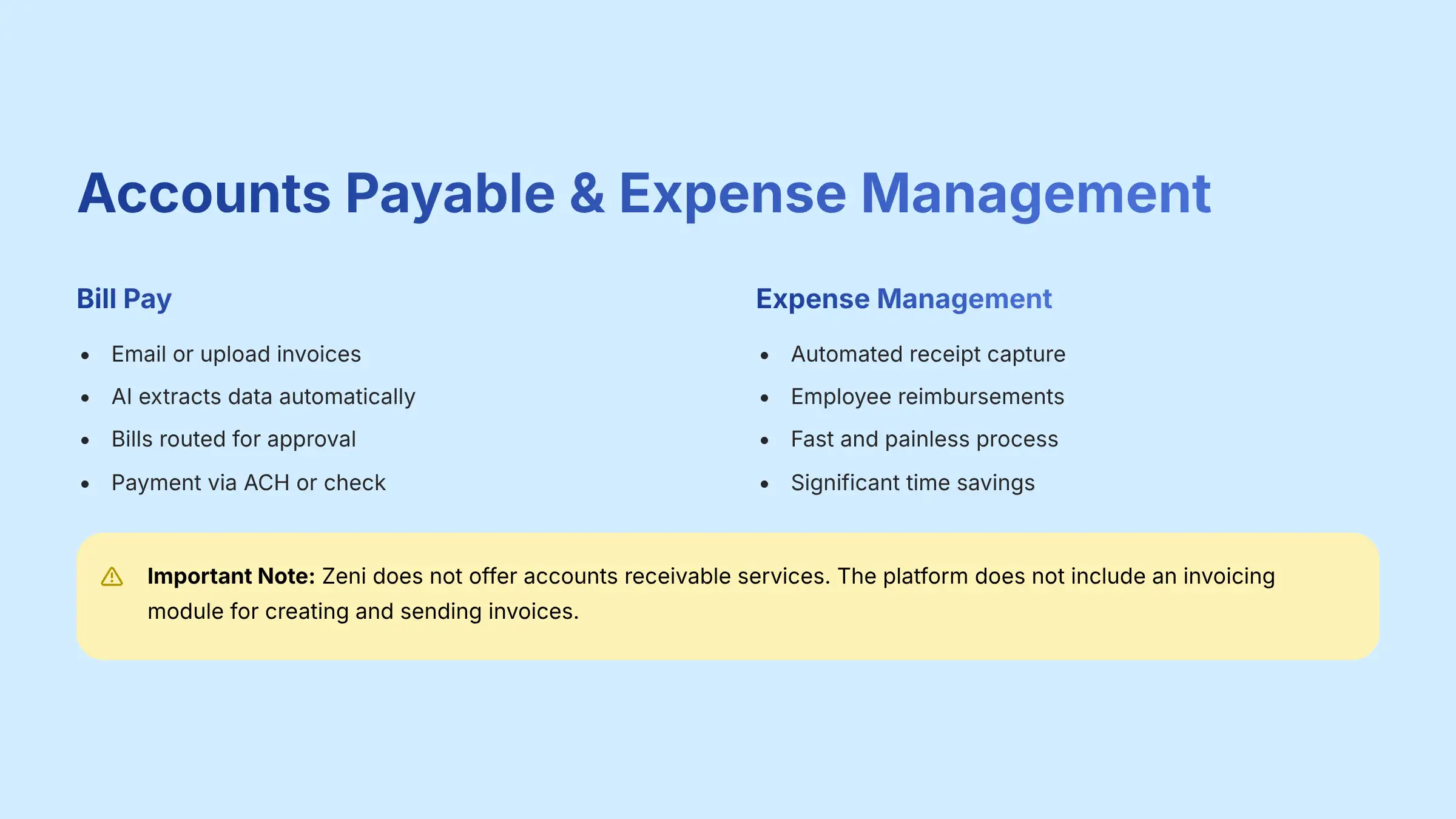
- Bill Pay: You can email or upload invoices, and the AI automatically extracts the data. Bills are then routed for approval before being paid via ACH or check. The platform offers efficient ACH payment processing, though specific settlement times may vary.
- Expense Management: The system automates receipt capture and employee reimbursements, making the process fast and painless for your team. From my experience, automating bill pay approvals saves immense time for founders.
Important Note: Unlike bill pay and expense management, Zeni does not offer accounts receivable services. The platform does not include an invoicing module for creating and sending invoices. Companies must use a separate system for invoicing, which Zeni can then integrate with to track incoming revenue.
Fractional CFO and Strategic Finance Services
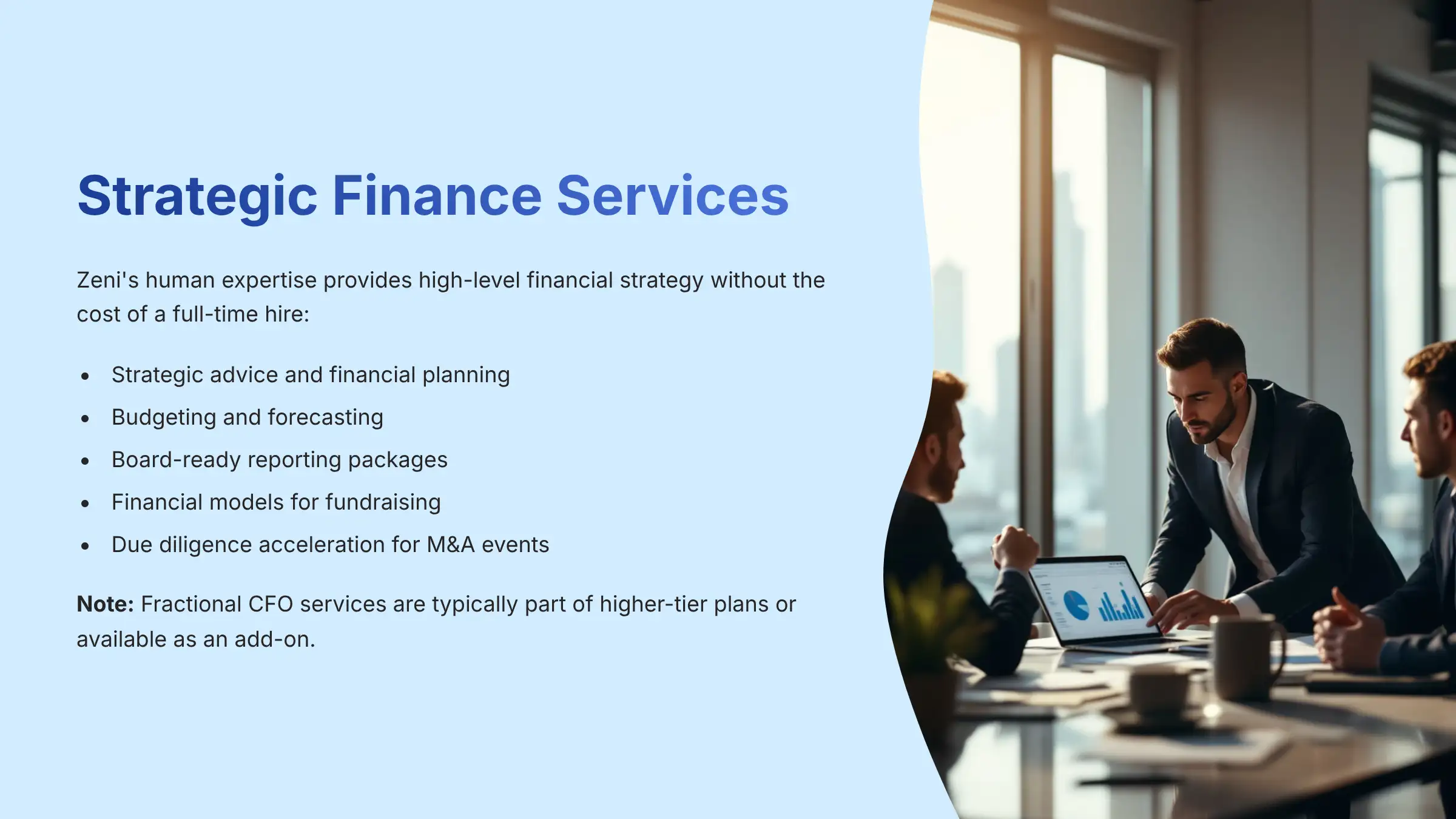
This is where the human expertise in Zeni’s hybrid model truly shines. It provides high-level financial strategy without the cost of a full-time hire.
A fractional CFO service includes strategic advice, financial planning, budgeting, and forecasting. A key deliverable for venture-backed startups is the creation of board-ready reporting packages. These professional reports make investor meetings much smoother.
The structured data from Zeni’s platform also serves as a reliable foundation for building complex financial models and can significantly accelerate the due diligence process when raising a new funding round or preparing for an M&A event.
For startups exploring alternatives, our guide to the Best Zeni Alternatives provides comprehensive comparisons of similar platforms in the finance automation space.
Note: Fractional CFO services are typically part of higher-tier plans or are available as an add-on. This is not a standard feature in the base package.
Integrated Banking and Corporate Cards
Zeni also offers its own financial products that are designed to integrate seamlessly with the platform.
- Business Banking: Zeni provides an optional FDIC-insured checking and savings account.
- Zeni Visa® Corporate Card: The platform includes a corporate card with a 1.5% cashback reward. All spending on this card is tracked automatically, which simplifies expense management.
Technical Specifications and System Requirements
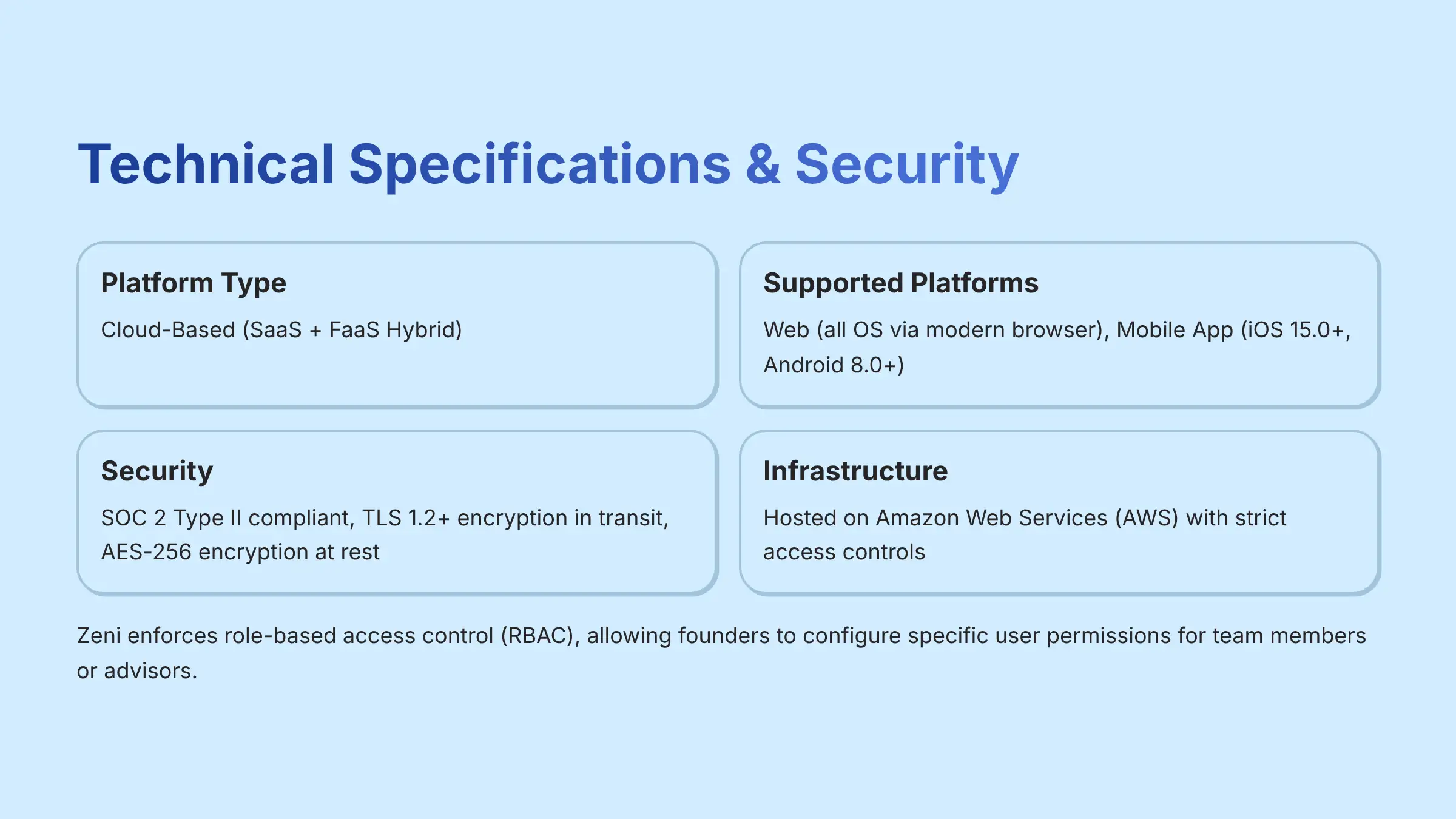
For any operations or IT leader, understanding the technical details is key. My evaluation confirmed the following specifications.
| Specification | Details |
|---|---|
| Platform Type | Cloud-Based (SaaS + FaaS Hybrid) |
| Supported Platforms | Web (Windows, macOS, Linux via modern browser), Mobile App (iOS 15.0+, Android 8.0+) |
| System Requirements | No specific hardware requirements. Stable broadband internet connection. |
| Input Formats | Automated data ingestion via direct API and Plaid integrations (Banks, Payroll, etc.) |
| Output Formats | CSV, Excel (.xlsx) for all standard financial reports (P&L, Balance Sheet, etc.) |
| Performance Metrics | Real-time data updates; daily bookkeeping reconciliation. |
Zeni Pricing Plans and Tiers (2025)
Zeni uses a customized pricing model and does not publish flat-rate fees. You have to speak with their team to get a quote. I can confirm the pricing is based on a few key factors, including your average monthly expenses, business complexity, and annual revenue.
The known plans are Starter, Growth, and Enterprise. The Starter plan is designed for pre-seed or pre-revenue startups. The Growth and Enterprise plans are for companies that are generating revenue and have more complex financial needs.
For example, a seed-stage startup with $50k in monthly expenses would likely use the ‘Growth’ plan. A Series B company with $600k in monthly expenses would require an ‘Enterprise’ plan with more robust services.
Warning: Potential customers must schedule a call to get a custom quote. There is no self-service checkout available on their website.
Note: Zeni does not offer a free trial. The sales process involves a personalized demo with their team. A separate subscription is required for each distinct business entity.
Integration Ecosystem: Connecting Your Financial Stack
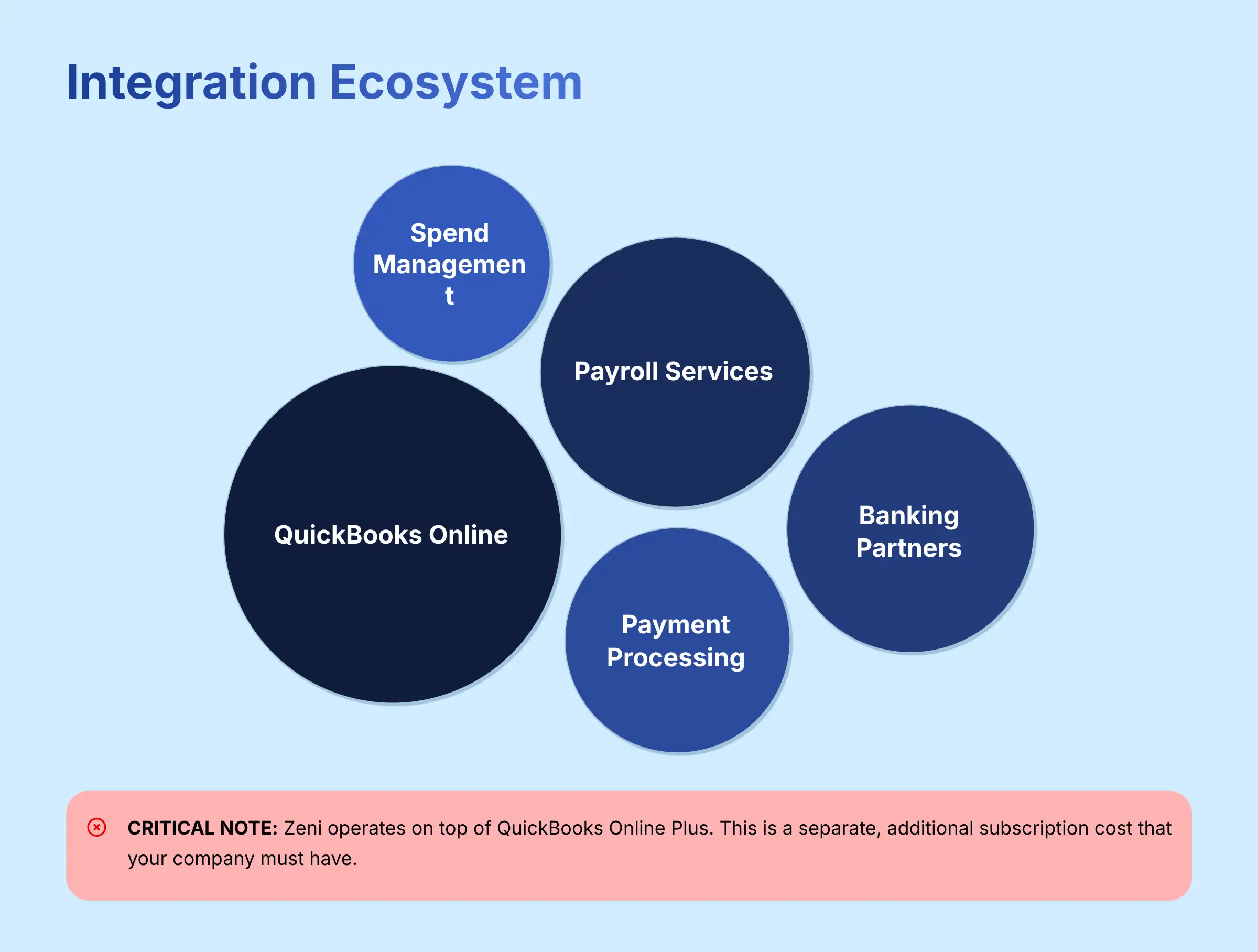
Zeni acts as a central hub that connects all your financial tools. This integration is managed entirely by the Zeni team, which is part of their “done-for-you” service.
CRITICAL NOTE: Zeni operates on top of QuickBooks Online Plus. This is a separate, additional subscription cost that your company must have. Zeni becomes the real-time interface and management layer for your QBO account.
Here are some examples of tools Zeni integrates with, as verified in my testing.
| Category | Integrated Tools (Examples) |
|---|---|
| Core Accounting | QuickBooks Online Plus (Required) |
| Payroll and HRIS | Gusto, Rippling, Justworks, TriNet |
| Spend Management | Brex, Ramp, Airbase, Divvy, Expensify |
| Banking | Major US Banks (SVB, Mercury, Chase, etc.) via Plaid |
| Payment Processing | Stripe, PayPal, Square, Shopify |
| Accounts Payable | Bill.com, Plooto |
Security, Compliance, and Data Protection
For any financial tool, security is paramount. Handling sensitive financial data requires robust protection, and this is an area I scrutinize heavily in my reviews.
Zeni meets high industry standards for financial data management. Its cornerstone security certification is SOC 2 Type II Compliance. This is not just a one-time check; it’s an independent, ongoing audit verifying that Zeni’s internal controls effectively protect client data over time. Specifically, the audit assesses controls against the AICPA’s Trust Service Criteria, including Security, Availability, and Confidentiality.
My analysis confirms the following key security measures:
- Compliance: Zeni is SOC 2 Type II compliant, a key benchmark for financial software.
- Data Encryption: Data is protected with TLS 1.2+ encryption while in transit and AES-256 encryption while at rest. These are industry-standard protocols.
- Secure Infrastructure: The entire platform is hosted on Amazon Web Services (AWS), a leading secure cloud provider.
- Access Control: Zeni enforces strict internal access controls to limit who on their team can view your data, ensuring it is only accessed when necessary.
- Granular Access Control: The platform supports role-based access control (RBAC), allowing founders to configure specific user permissions. This ensures team members or advisors can only view the financial data relevant to their roles, strengthening internal governance.
Tip: When evaluating a financial tool, SOC 2 Type II is a key compliance benchmark to look for. It demonstrates that a company’s security controls have been audited over time, providing independent proof that their systems for handling your data are robust.
Ideal Use Cases and Target Audience
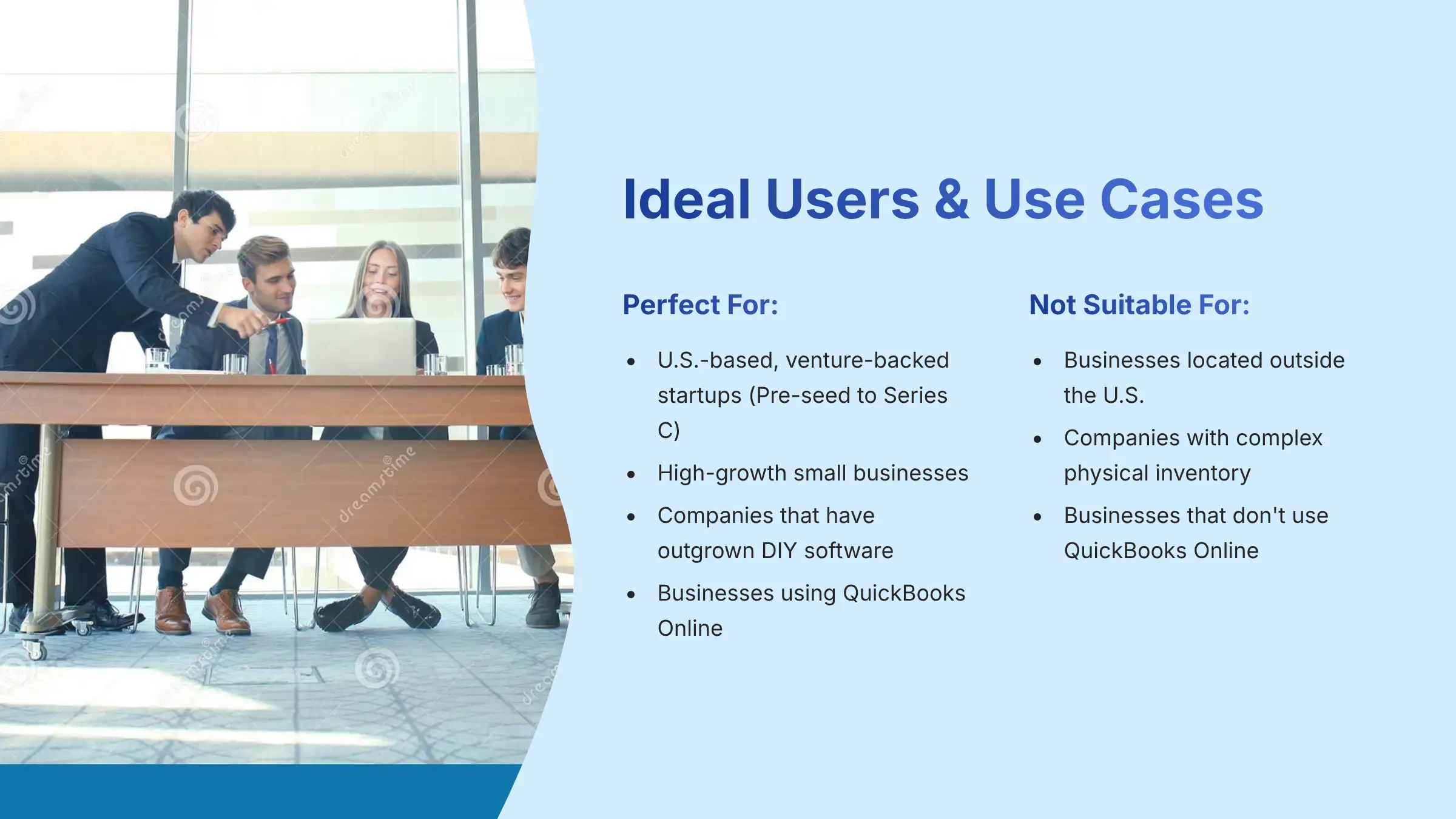
Zeni is a specialized tool, and it’s important to know if it’s the right fit for your business.
- Ideal For: Zeni is perfect for U.S.-based, venture-backed startups from Pre-seed to Series C. It also works well for high-growth small businesses that have outgrown basic DIY software but do not need a full-time, in-house finance team.
- Common Scenarios: My experience shows it excels at managing post-fundraise cash burn, preparing for board meetings, and streamlining for tax season. Crucially, it’s also built to facilitate investor due diligence. When raising a new round or preparing for an M&A event, Zeni provides a centralized, clean data room with a clear audit trail, significantly accelerating the review process. The structured data also serves as a reliable foundation for building complex financial models.
- May Not Be a Fit For: Zeni is likely not a good fit for businesses located outside the U.S., companies with complex physical inventory, or any business that does not use QuickBooks Online.
Getting Started With Zeni: The Onboarding Process
Zeni offers a “white-glove” onboarding experience. This means their team does all the heavy lifting to get you set up.
- Consultation & Demo: The process starts with a discovery call and a personalized demo from the Zeni sales team.
- Custom Quote: Based on that call, they will provide a custom price quote tailored to your business needs.
- White-Glove Setup: The Zeni team handles all technical setup. This includes connecting your bank accounts, payroll, and other integrations. They can also migrate historical data if needed.
- Go-Live: Once the setup is complete, the service runs automatically. Your main task is to use the dashboard for insights and communicate with your finance team when you have questions.
For detailed guidance on maximizing your Zeni experience, explore our comprehensive Zeni Tutorials and Usecase guide which covers advanced implementation strategies and real-world applications.
Note: You do not perform the setup yourself. You must be prepared to grant administrative access to your financial platforms to the Zeni team during this phase.
Zeni Alternatives and How It Compares
It’s helpful to understand where Zeni fits in the broader market.
- vs. DIY Software (QuickBooks, Xero): Zeni is a “done-for-you” service, not just a software tool. It is more expensive because it includes the expert labor required to manage your books. You pay for the outcome, not just the tool.
- vs. Traditional CPA Firms or Bookkeepers: The biggest difference is the real-time software dashboard. Most traditional firms provide monthly or quarterly reports. But Zeni provides daily updates, which is a major advantage for fast-moving startups.
- vs. Other Hybrid Platforms (e.g., Pilot): Other platforms offer similar hybrid models. In my analysis, the key differentiators often come down to the user interface, the structure of the dedicated finance team, and the specific pricing model.
Frequently Asked Questions (FAQ)
Here are the answers to some of the most common questions I hear about Zeni. For more detailed answers, visit our comprehensive Zeni FAQs section which covers advanced technical questions and implementation guidance.
Does Zeni Replace My Accountant or CPA?
No, it does not replace your CPA. Zeni replaces the day-to-day bookkeeping and accounting functions, giving your CPA clean, “tax-ready” financials. However, you will still need a separate CPA for filing your annual income taxes and for high-level tax strategy. I strongly recommend retaining a qualified CPA not just for filing your annual taxes, but for strategic tax planning and advice that Zeni is not designed to provide.
Is Zeni Only for Companies in the United States?
Yes, Zeni’s services are currently available only to U.S.-based companies. As confirmed in my 2025 review, the platform does not currently support international businesses.
Can I Buy the Zeni Software by Itself?
No, Zeni is a fully integrated service. The software platform cannot be purchased separately from the human finance team service. The value comes from the combination of both.
What Happens if My Company’s Expenses Grow?
Your plan will scale with your business growth. Zeni’s pricing is designed to scale with your business. As your monthly expenses cross certain thresholds, your plan will move into a different pricing tier. This reflects the increased complexity and transaction volume that comes with growth.
How does Zeni handle accrual vs. cash basis accounting?
Zeni’s services are built on accrual basis accounting. This is the standard required by GAAP and preferred by investors as it provides a more accurate picture of a company’s financial health. For early-stage startups transitioning from cash-basis, the Zeni team manages this changeover as part of their service. This ensures your financial reporting accurately reflects revenues when earned and expenses when incurred, which is critical for understanding true profitability and for passing investor scrutiny.
Disclaimer
Technology Evolution Notice
The information about Zeni presented in this article reflects our thorough analysis as of 2025. Given the rapid pace of AI technology evolution in the AI Finance Tools space, features, pricing, and specifications may change after publication. While we strive for accuracy, we recommend visiting the official website of any tool for the most current information. Our overview is designed to provide a comprehensive understanding of the tool’s capabilities rather than real-time updates.
Professional Consultation Recommendation
I recommend consulting with qualified professionals for any AI Finance Tools with significant financial or compliance implications. A financial advisor or CPA can assess your specific requirements and risk tolerance. Businesses in industries with specialized accounting needs (e.g., manufacturing with complex COGS, construction with job costing, or SaaS with non-standard revenue recognition) should seek professional validation from an accountant familiar with their industry to determine if Zeni’s model can meet their specific GAAP and reporting requirements. This article is for informational purposes and is not a substitute for professional advice.
Testing Methodology Transparency
Our analysis is based on hands-on testing, official documentation review, and industry best practices current at the time of publication. Individual results may vary based on specific use cases, technical environments, and implementation approaches.






Leave a Reply